
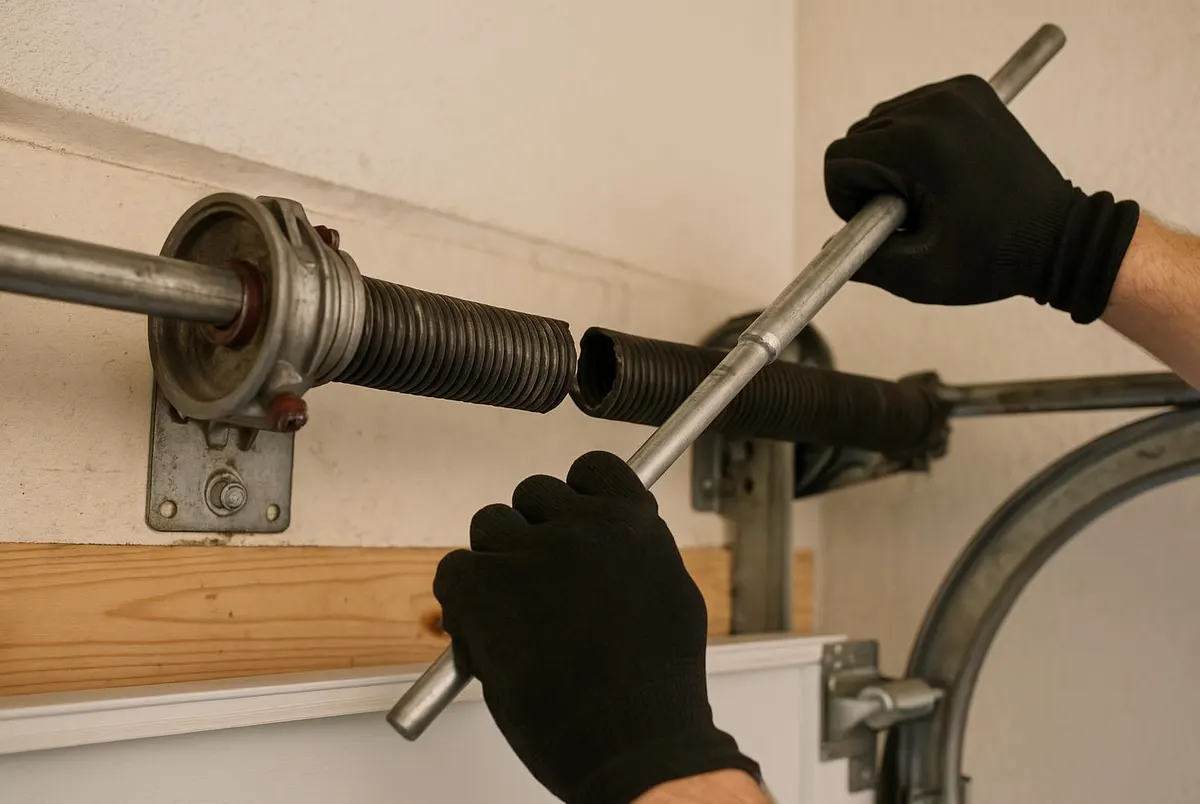
What a Technician Sees on a Typical Call
The call usually starts the same way: "It's been making a weird noise for a few weeks, but it still opens fine." Then the technician gets the door up and finds rust bleeding down the cable drum, a few bent or broken wire strands poking out near the bottom bracket, and rollers so worn they've gone from round to slightly oval. None of it happened overnight. It built up quietly for months while the door kept working — until the day it didn't.
Cables and Rollers Do Different Jobs — and Fail Differently
This is usually where the spouse argument starts: one person thinks any grinding noise means the springs are about to snap, the other thinks it's nothing. The truth is cables and rollers are separate parts with separate failure patterns, and neither one is "nothing."
Frayed Cables
The cables are the steel lines that run from the bottom brackets up to the drums near the springs. They carry serious tension, especially on heavier doors. Warning signs include:
- Visible fraying or "broom-strawing" — individual wire strands sticking out
- Rust streaks on the drum or along the cable itself
- The door hanging slightly crooked, with one side lower than the other
- A popping or snapping sound right as the door starts to move
A frayed cable doesn't always announce itself with noise. Sometimes the first sign is a door that looks tilted. That's a bigger deal than it sounds — a cable that lets go while the door is up can drop one side of the door suddenly and hard.
Worn Rollers
Rollers are the wheels that ride inside the track and let the door glide up and down. They wear out from friction, age, and grit in the track. Signs of trouble:
- A rhythmic grinding or rumbling as the door moves, louder than before
- Jerky or hesitant movement instead of a smooth glide
- Visible flat spots, cracks, or chunks missing from the roller wheel
- The door shaking side to side instead of running straight
Worn rollers are more of a slow-decline problem than a sudden-failure one. The door gets louder and rougher over weeks or months. It's annoying before it's dangerous — but it does eventually lead to a door that jumps the track.
Why This Wears Out Faster Here Than It Would Up North
North Port's climate is hard on garage door hardware in ways a lot of homeowners don't expect. Afternoon downpours and hurricane-season humidity keep moisture in the air almost constantly, and that moisture gets into cable strands and roller bearings even in a closed garage. Add salt air if you're anywhere near the coast — Englewood, Osprey, Punta Gorda — and steel parts rust faster than the manufacturer's spec sheet assumes. Humidity also makes wood-composite panels swell slightly, which throws off alignment and puts extra strain on rollers that are already working harder to track straight. None of this means the parts are defective. It means the environment asks more of them than a dry climate would.
So Who's Right — Is It Dangerous or Just Annoying?
Both of you, depending on which part is the problem. A noisy roller is a maintenance issue: it's wearing down, it needs attention, but it's not likely to fail catastrophically overnight. A frayed cable is a safety issue: it's load-bearing, and a full break can let a heavy door drop or swing off balance while someone is standing under it. If the noise is a steady rumble and the door still runs straight, you've probably got rollers. If the door looks crooked, hangs unevenly, or you can see wire strands sticking out anywhere along the cable run, stop using the door and treat it as urgent.
What Happens If You Ignore It
Worn rollers that keep grinding eventually bind in the track, forcing the opener motor to work harder — which shortens the life of the opener itself. A frayed cable that's left alone doesn't heal; it gets thinner and weaker every cycle until it lets go, usually without much warning. Either way, waiting turns a straightforward repair into a bigger one, and in the cable's case, a potentially dangerous one.
Quick Checks You Can Do From the Driveway
- With the door closed, look at both cables from bottom bracket to drum for fraying or rust
- Check that the door sits level — not higher on one side
- Open and close it once, listening for grinding versus a clean snapping sound
- Look at the rollers themselves (carefully, door closed) for flat spots or cracks
If anything looks off, don't try to tension or replace a cable yourself — that's spring-adjacent work and it's not worth the risk.
When to Call North Port Garage Door Service
If you're seeing fraying, rust on the cables, or a door that hangs crooked, call us for cable replacement before it fails on its own schedule instead of yours. If it's rumbling, shaking, or running rough but otherwise tracking straight, our cable & roller replacement service swaps worn rollers for ones built to handle this climate, and we'll check the rest of the hardware while we're in there. Either way, we diagnose it on site and tell you straight whether it's a same-visit fix or something bigger.
If your garage door in North Port, Port Charlotte, Venice, or anywhere nearby is making noise it didn't used to make, call North Port Garage Door Service and let us take a look before it decides to make the call for you.